Skip to the calculator
Bent duct elbow logoDuctRise

DuctRise calculators › Conduit bending calculator

Conduit bending calculator for offsets, saddles and stubs

Choose the bend, enter the height to clear and the bend angle, and this conduit bending calculator returns the distance between marks, the shrink and the developed length. It covers offsets, 3-point saddles, 4-point saddles and 90 degree stubs for EMT, IMC and rigid conduit bent on a hand or bench bender.


Advanced options


Calculations run in your browser. The numbers you enter are not sent to a server.

Offset multipliers and shrink by bend angle

Distance between marks is the offset height times the multiplier. Shrink is how much shorter the conduit run ends up. The last two columns work a 6 in offset.

Bend angleMultiplierShrink per inch of offsetMarks for a 6 in offsetShrink for a 6 in offset
10°5.7590.087 in34.55 in0.52 in
22.5°2.6130.199 in15.68 in1.19 in
30°2.0000.268 in12.00 in1.61 in
45°1.4140.414 in8.49 in2.49 in
60°1.1550.577 in6.93 in3.46 in
Illustration of an electrician in gloves bending a length of EMT conduit with a hand bender, one boot on the bender's foot pedal
Illustration: a hand bender in use. The calculator gives the marks to place on the conduit before it goes into the bender.
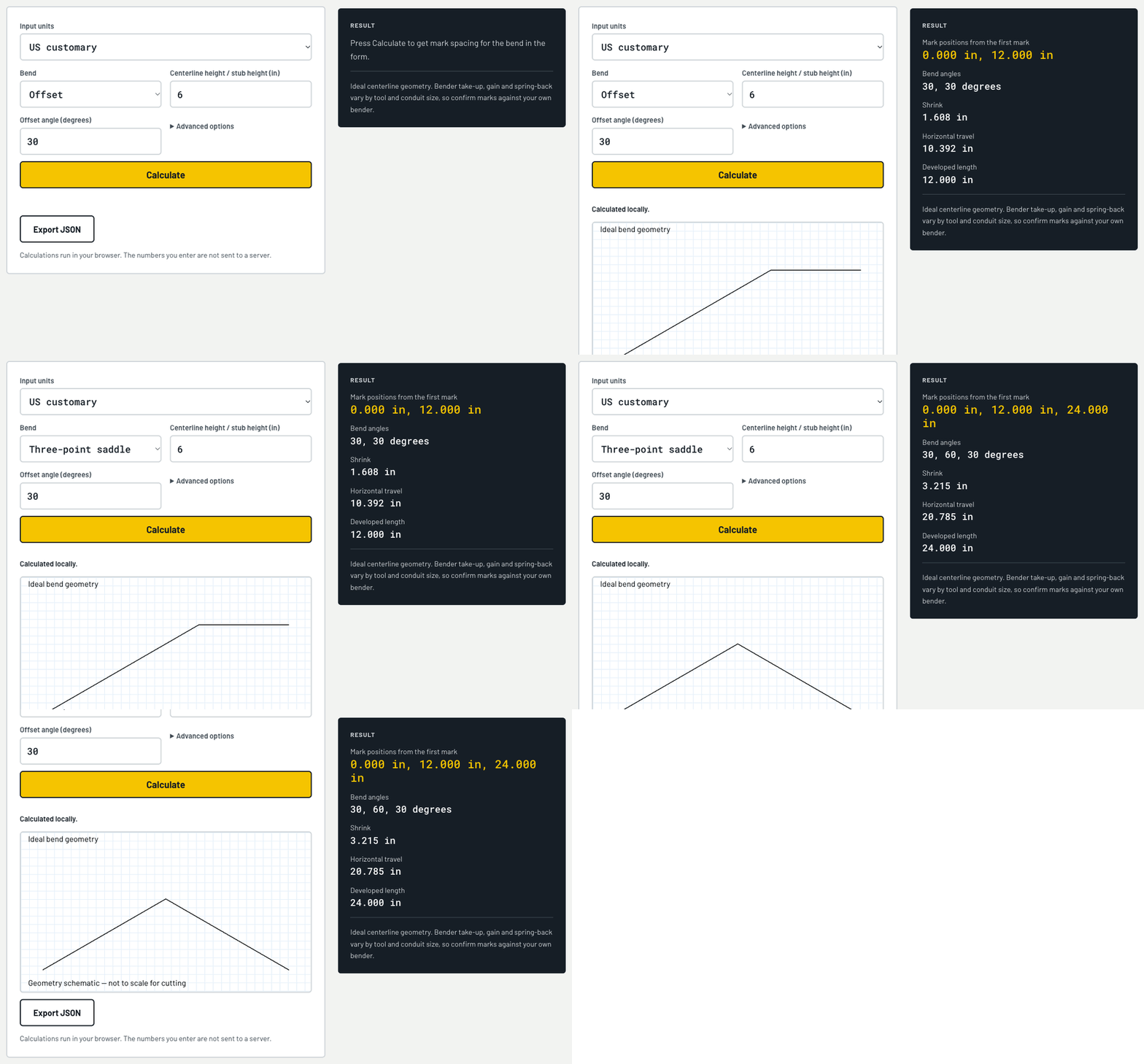
Screen recording of the conduit bending calculator: a 6 in offset at 30 degrees gives marks at 0 and 12 in, then the bend is switched to a three-point saddle, which gives marks at 0, 12 and 24 in
Screen recording of this calculator: a 6 in offset at 30 degrees gives marks at 0 and 12 in with 1.608 in of shrink; switching to a 3-point saddle gives marks at 0, 12 and 24 in with 3.215 in of shrink.

What each bend type returns

Offset

Two bends of the same angle in opposite directions. The calculator gives two marks: the first, and a second at offset height divided by the sine of the angle.

Shrink is that distance minus the horizontal travel, which works out to the offset height times the tangent of half the angle.

3-point saddle

A center bend of twice the outer angle with one outer bend each side, so entering 22.5 gives a 22.5, 45, 22.5 saddle. The outer angle can be up to 45 degrees.

Three marks are returned, evenly spaced, and the shrink is double that of a single offset of the same height.

4-point saddle

Two offsets back to back with a flat section between them, for crossing a wide obstruction. Enter the flat length in the Saddle flat length field.

Four marks are returned: the two bends up, then the two bends back down after the flat.

90 degree stub

A stub mark is the stub height minus your bender's take-up. Take-up differs by bender and conduit size, so the calculator asks you to type the measured take-up and name the tool before it shows a mark.

Add a measured bend radius to also get arc length and gain. Without a radius those two lines ask for one instead of guessing.

Conduit bending questions

Is this an EMT bending calculator?

Yes. Offset and saddle spacing depends only on height and angle, so the same numbers apply to EMT, IMC and rigid. What changes between conduit types and sizes is the bender's take-up and radius, which you enter yourself.

Can I use it as a pipe bending calculator?

The offset and saddle geometry holds for any round material bent to a centerline angle. It does not model wall thinning, spring-back or minimum bend radius for pressure pipe or tube, so use it for layout marks only.

Why is there no default take-up?

Take-up printed on a bender applies to that bender and one conduit size. A wrong default would give a wrong stub, so the field is left blank until you enter the figure from your tool.

What are measured mark offsets?

If your bender's arrow or star does not land exactly on the ideal mark, enter the correction for each mark, separated by commas, with a tool reference. The result then lists calibrated marks alongside the ideal ones.

DuctRise runs every calculation in your browser. Results are geometry and airflow estimates for the numbers you enter. They are not a design approval or a code check.