Skip to the calculator
Bent duct elbow logoDuctRise

Ductulator: HVAC duct calculator for velocity, friction and size

This online ductulator takes airflow in CFM and a round or rectangular duct and returns air velocity, friction loss per 100 ft and the equivalent duct size. Leave the round diameter blank to check a rectangular duct, or enter a target velocity or friction rate to have a round size worked out for you.


Advanced options


Calculations run in your browser. The numbers you enter are not sent to a server.

Duct calculator examples at standard air

Each row was worked with this calculator's defaults: air density 1.2 kg/m³ and galvanized steel roughness of 0.09 mm. Use them to check that your own entries are in the range you expect.

AirflowDuctVelocityFriction per 100 ftEquivalent round
600 CFM10 in round1,100 FPM0.180 inWC10.00 in
1,000 CFM12 in round1,273 FPM0.188 inWC12.00 in
1,000 CFM14 in round935 FPM0.088 inWC14.00 in
1,000 CFM12 × 10 in1,200 FPM0.190 inWC11.96 in
1,000 CFM16 × 8 in1,125 FPM0.173 inWC12.19 in
1,500 CFM16 in round1,074 FPM0.097 inWC16.00 in
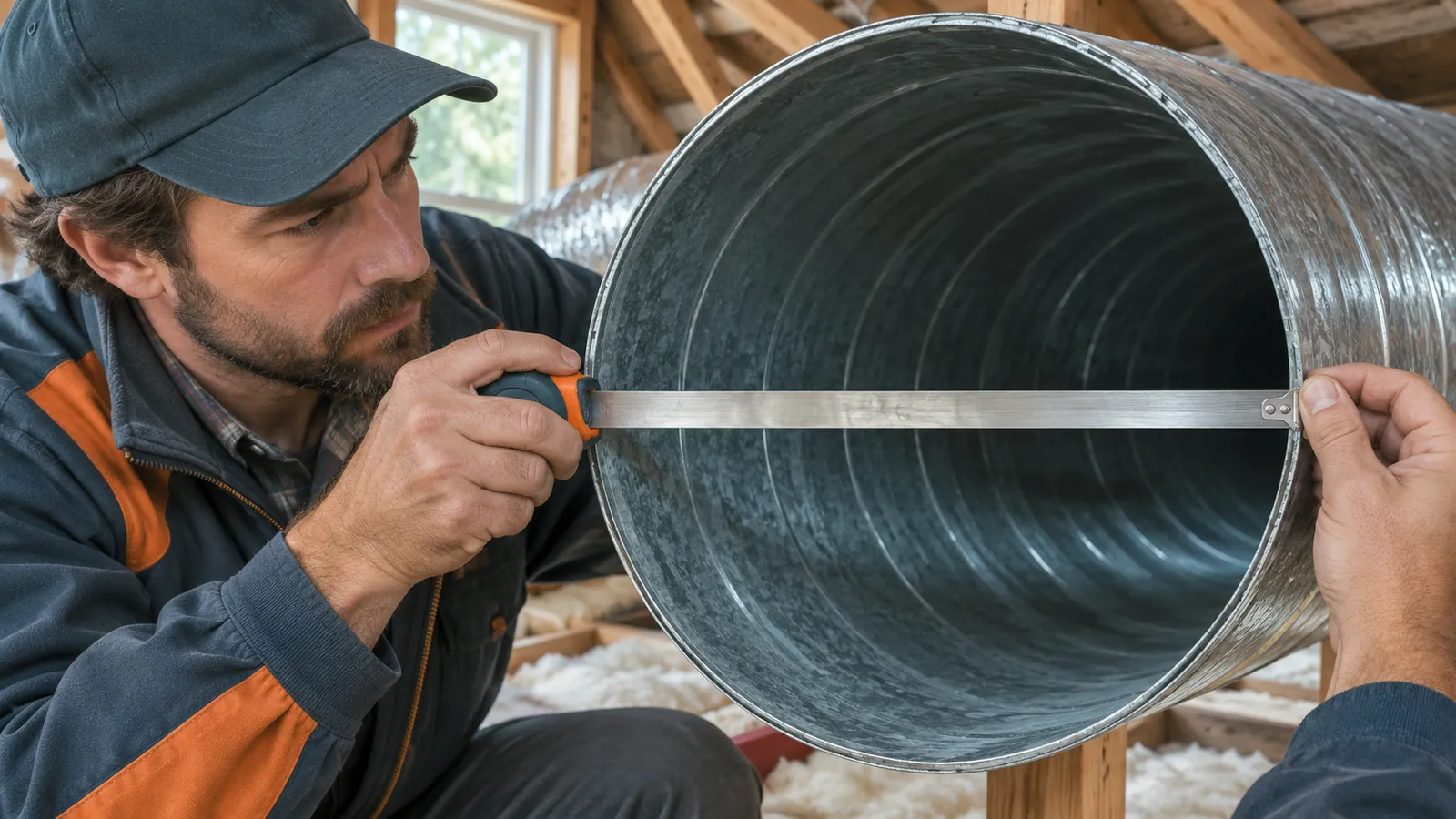
Illustration of an HVAC technician holding a steel tape across the open end of a round galvanized duct in an attic
Illustration: a tape held across the open end of a round duct gives the diameter to enter in the calculator.
Screen recording of the ductulator: 1000 CFM in a 12 in round duct reads 1273.2 FPM, then the round diameter is cleared and a 12 by 10 in rectangular duct reads 1200.0 FPM, and the Advanced options section is opened to show air density, viscosity and roughness
Screen recording of this calculator: 1,000 CFM in a 12 in round duct gives 1273.2 FPM and 0.1884 inWC per 100 ft; clearing the diameter and using a 12 × 10 in rectangle gives 1200.0 FPM. Air density, viscosity, roughness and the target fields sit under Advanced options.

How this HVAC duct calculator works

Velocity

Velocity is airflow divided by the inside area of the duct. At 1,000 CFM a 12 in round duct has 0.785 sq ft of area, which gives 1,273 FPM.

For a rectangular duct the area is simply width times height, so a 12 × 10 in duct carries the same 1,000 CFM at 1,200 FPM.

Friction loss

Friction is calculated with the Darcy-Weisbach equation, using the Colebrook relation for the friction factor in turbulent flow. Rectangular ducts use their hydraulic diameter.

The Material list sets roughness: 0.09 mm for galvanized, 0.045 mm for steel, 0.03 mm for aluminum and 0 for a smooth wall. You can overwrite the roughness, air density and viscosity fields with your own values.

Equivalent sizes

A rectangular duct is converted to the round duct with the same friction at the same airflow using the equal-friction formula 1.30 × (a × b)^0.625 / (a + b)^0.25.

The Equivalent rectangle ratio field runs that in reverse. A 12 in round duct matches about 11 × 11 in at a ratio of 1, 15.75 × 7.88 in at 2 and 19.71 × 6.57 in at 3.

Sizing from a target

Enter a target velocity in FPM, or a target friction rate in inWC per 100 ft, and the calculator solves for the round diameter that meets it, then reports that duct's velocity and friction.

Limits of the model: rectangular aspect ratio up to 4, and no friction value when the flow falls between laminar and fully turbulent. In that case the result shows the flow as outside the model range.

Ductulator questions

What is a ductulator?

A ductulator is a duct sizing calculator. The original is a cardboard slide chart that relates airflow, duct size, velocity and friction rate. This page does the same job from typed numbers and shows the assumptions it used.

Why does my result differ from a paper ductulator?

Slide charts are printed for one air density and one roughness and are read by eye. This calculator solves the friction equation directly for the density, viscosity and roughness in the form, so small differences are expected.

Does the friction result include elbows and fittings?

No. It is the loss in straight duct only, per 100 ft. Fitting losses, flex duct and dampers have to be added from fitting data for your system.

Can I work in metric?

Yes. Switch Input units to Metric to enter airflow in m³/h and sizes in mm, and to read velocity in m/s and friction in Pa/m.

DuctRise runs every calculation in your browser. Results are geometry and airflow estimates for the numbers you enter. They are not a design approval or a code check.